Seller concessions on VA loans allow a home seller or builder to pay certain buyer costs at closing, helping eligible Veterans, active-duty service members, and qualifying surviving spouses reduce their out-of-pocket expenses when buying a home.
Under VA guidelines, seller concessions are generally limited to no more than 4% of the home’s reasonable value, but that cap does not include normal closing cost credits the seller may agree to pay. This means a VA buyer may be able to negotiate help with standard closing costs while also using seller concessions for items such as the VA funding fee, prepaid taxes and insurance, debt payoff, or certain temporary buydowns.
For VA homebuyers in Dallas-Fort Worth and across Texas, understanding seller concessions can make a major difference in how much cash you need at closing. In this guide, Ginger Varga explains what counts toward the VA 4% rule, what does not count, how seller-paid costs work, and how to negotiate concessions the right way when buying a home with a VA loan.
| Key Point | What It Means for VA Buyers |
|---|---|
| Seller concessions reduce upfront costs | The seller or builder can agree to pay certain buyer expenses at closing, helping reduce how much cash the VA buyer needs to bring. |
| The VA 4% rule applies to concessions | VA seller concessions are generally capped at 4% of the home’s reasonable value. (Veterans Affairs) |
| Closing cost credits are separate | The VA allows sellers or builders to cover some or all buyer closing costs, and those credits are not treated the same as seller concessions. (Veterans Affairs) |
| Concessions can cover more than basic closing costs | They may include items such as the VA funding fee, prepaid taxes, hazard insurance, buyer debt payoff, judgments, or temporary buydowns. (Benefits Home Page) |
| The VA funding fee may be paid by the seller | This can lower the buyer’s cash needed at closing, especially for buyers who do not want to finance the funding fee into the loan. |
| Negotiation matters | Seller concessions must be written into the purchase agreement and reviewed by the lender to make sure they follow VA guidelines. |
| A VA-experienced Realtor helps protect the deal | An agent familiar with VA loans can help structure the offer, request the right concessions, and avoid issues with the lender, appraisal, or contract terms. |
Key Highlights
- Seller concessions on VA loans help reduce buyer cash needed at closing.
- VA concessions are generally capped at 4% of the home’s reasonable value.
- Normal seller-paid closing costs do not count the same way as concessions.
- Concessions may cover the VA funding fee, prepaid taxes, insurance, debts, judgments, or temporary buydowns.
- The seller can pay some or all buyer’s closing costs if negotiated in the contract.
- The concession amount must be approved by the lender and comply with VA rules.
- Working with a VA-experienced Texas Realtor can help buyers negotiate these benefits correctly.
What Are Seller Concessions on a VA Loan?
When a seller agrees to cover closing costs, these are called seller concessions. These help make the initial cost of owning a home more affordable for prospective buyers. Thus, it can be requested during the negotiation process. They are also known as seller contributions or seller credits.
These concessions represent expenses that the seller agrees to cover, making the transaction feasible and attractive for the buyer.
The incentives involve covering the following –
- Buyer’s VA funding fee
- Property taxes
- Hazard insurance
- Additional expenses that the buyer is accountable for.
Seller concessions aim to lower the buyer’s upfront costs, making the purchase easier and more affordable. Understanding seller concessions helps buyers navigate the home-buying process and secure favorable terms.
Key Note:
- Seller concessions do not include standard closing costs or points. These are still the buyer’s responsibility.
- Title insurance is required for lenders and usually not viewed as a concession.
- It also covers attorney fees, which are required in some states, based on the negotiations.
How VA Seller Concessions Differ from Conventional Loans?
Unlike many traditional loans, VA loans do not require a down payment or mortgage insurance. However, there is a funding fee associated with it.
The amount is based on the house’s price and constitutes a percentage of your down payment. If it’s 10% or higher, the VA funding fee is 1.25% of the home’s sale price.
If your down payment is between 5% and 9%, the fee increases to 1.5%; if it’s below 5%, the fee is 2.15%.
The VA permits sellers to help with the funding fee and various closing costs. However, sellers must not ignore a crucial aspect.
Closing costs are not considered as a “seller concession.” The seller may cover those confusing fees, but they won’t contribute a cent to the 4% concession cap.
When it comes to seller concessions, VA and conventional loans follow distinct rules and limitations.
What distinguishes VA seller concessions is:
- Higher Allowable Limit: The VA allows sellers to contribute up to 4% of the loan amount toward the buyer’s closing costs and other expenses. This cap is quite generous when compared to conventional loans, where the limits are lower. It varies depending on the mortgage type and the buyer’s down payment amount.
- Seller Concessions Cover: VA seller concessions can extend beyond just covering closing costs. They may be used to pay prepaid taxes and insurance, settle collections or judgments for the buyer, and cover the VA funding fee. On the other hand, conventional loan concessions only cover the closing costs and cannot be used for debt payoff or funding fees.
- Who Benefits Most: VA seller concessions are designed to make homeownership more accessible for veterans and active-duty service members by minimizing their initial expenses. It can be beneficial for buyers with limited cash on hand. Traditional loan concessions can also assist, but their adaptability and effects are typically more restricted.
- VA’s Unique Rules: The VA has specific criteria for what qualifies as a seller concession. For instance, the 4% cap does not account for regular closing expenses the seller may cover. Only specific contributions are considered towards the cap. Traditional loans lack these specific definitions, leading to greater variability in rules across lenders.
VA Home Loan Seller Concessions Guidelines
According to VA regulations, a seller concession can be up to 4% of the sale price. It is in addition to the standard loan closing costs.
Some sellers are more inclined than others to offer concessions to sell their property.
When using VA Assumable Home Loans, the Department of Veterans Affairs establishes specific guidelines for seller concessions. It safeguards both the purchaser and the integrity of the loan program.
Here, we will discuss the home loan seller guidelines –
- Maximum Limit: The VA seller-concession limit is 4% of the total loan amount. This 4% limit is in addition to any typical closing expenses the seller may agree to cover. The limit is intended to prevent sellers from offering excessive incentives that might artificially raise the home’s price.
- Seller Concession includes: According to VA guidelines, seller concessions consist of contributions that exceed standard closing costs. It includes:
- Advance payment of real estate taxes and insurance.
- Payment of the VA funding charge.
- Settling collections, judgments, or liabilities for the buyer.
- Offering gifts, such as appliances, that are not part of the sales agreement.
- Payment of additional points to help the buyer in meeting loan qualifications.
- Purpose and Protection: The VA’s regulations are established to ensure equity for purchasers and vendors. By restricting seller concessions, the VA maintains the home’s true value and prevents inflated prices or hazardous loan arrangements.
- Adaptability and Negotiation: Buyers and sellers negotiate which expenses the vendor will pay, but both parties must adhere to VA regulations. Lenders will monitor these details and ensure the concessions comply with VA regulations before loan closing.
Understanding these regulations helps both buyers and sellers make the most of a VA loan and avoid surprises throughout the closing process.
Why Seller Concessions Matter for VA Buyers?
Seller concessions can greatly benefit VA buyers, particularly those who may not have substantial savings reserved for closing costs or initial expenses.
Here we will discuss why these concessions matter:
- Reduce Out-of-Pocket Costs: VA buyers frequently enjoy the advantage of no down payment. However, they still need to address closing costs and additional fees. Seller concessions help in covering these costs, enabling buyers to retain more of their cash reserves.
- Increased Affordability: Seller concessions enhance the affordability of homeownership by lowering the closing costs that buyers must pay. It is particularly beneficial for first-time purchasers or individuals moving from military service and starting anew financially.
- Flexibility to Address Financial Hurdles: Seller concessions may be utilized to settle specific debts or judgments, pay for prepaid taxes and insurance, or even reduce the VA funding fee. It helps buyers in meeting loan qualifications more easily or alleviates financial pressure during significant life changes.
- Enhanced Negotiating Power: Understanding that seller concessions are allowed and their functionality provides VA buyers with improved negotiating power. They can request that the seller cover certain expenses, enhancing the appeal or feasibility of their offer.
- Promotes Financial Stability: Reducing closing costs allows VA purchasers to retain additional funds for home maintenance, unexpected expenses, or upcoming expenses. It facilitates long-term success and stability for new homeowners.
What Costs Can Sellers Pay on a VA Loan?
When purchasing a home with a VA loan, the seller can choose to help and cover some of your expenses. When purchasing a home or a construction home with a VA loan, sellers help buyers by covering certain closing costs.
The Department of Veterans Affairs has specific regulations regarding the expenses sellers can cover, and understanding them can significantly impact negotiations.
Here we will discuss what costs sellers can cover to support VA buyers and make the home-buying process more affordable.
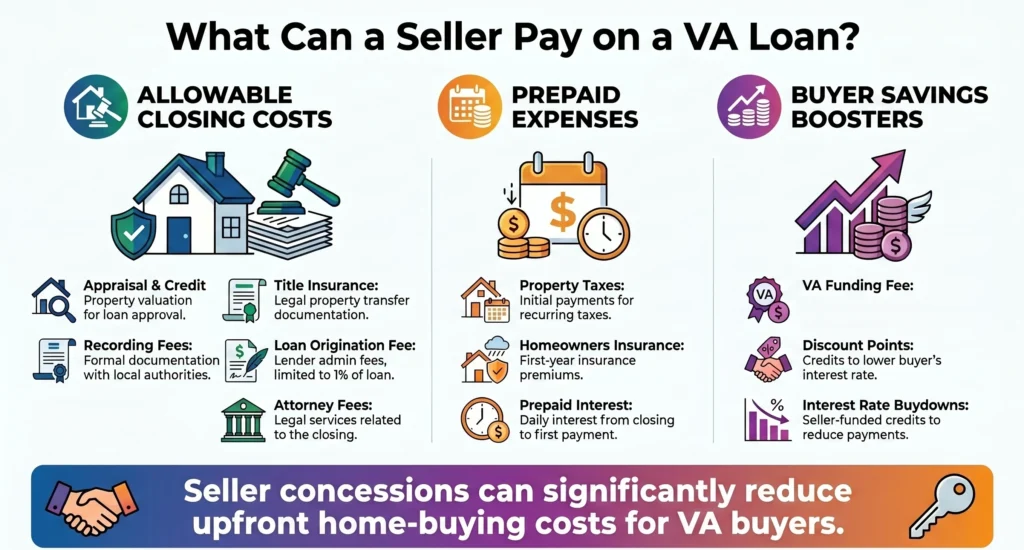
The VA Funding Fee and Seller Contributions
The majority of VA buyers pay a funding fee that supports the VA loan program. It can involve a significant amount of money, depending on the buyer’s situation and the initial payment. Though 100% disabled veterans may be exempt — learn more about disabled veteran benefits.
Sellers can cover this fee through their concessions, providing significant relief for buyers who might lack additional funds.
The VA funding fee is a high initial cost, often exceeding several thousand dollars for many buyers.
The VA’s regulations permit sellers to cover this fee for the buyer as part of their concessions, provided all concessions remain within the 4% limit of the loan amount.
When the seller pays the VA funding fee, it offers significant financial assistance for buyers. It directly decreases the cash required at closing, enabling qualified veterans and service members to retain more of their savings.
This flexibility is particularly crucial for buyers with limited finances or those who wish to maintain a financial buffer for moving costs, home improvements, or unexpected situations post-closing.
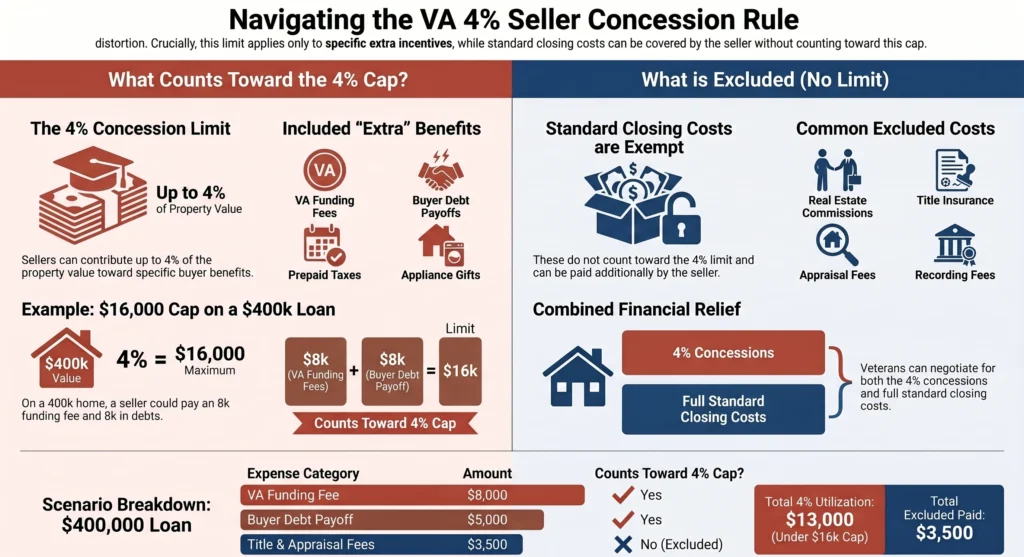
How Seller Concessions Benefit VA Buyers?
Seller concessions offer a significant chance for VA loan borrowers to handle initial costs. It can frequently be daunting, particularly when purchasing a home. These concessions can reduce veterans’ out-of-pocket expenses.
Here we will discuss how these concessions can create a significant impact:
- Reduce Out-of-Pocket Expenses: One of the major challenges for homebuyers is securing sufficient funds for closing expenses. Seller concessions enable sellers to pay for certain expenses, allowing VA buyers to retain more funds for moving costs, furniture, or savings.
- Help Cover Prepaid Items and Fees: VA buyers frequently need to prepay specific costs, including property taxes, homeowners’ insurance, and daily interest fees. Seller concessions help cover these initial expenses, reducing the financial burden at closing.
- Offset the VA Funding Fee: The majority of VA buyers need to pay a funding fee, which can amount to thousands of dollars. Sellers can cover this fee as part of the concessions, freeing the buyer’s funds for other purposes and making the loan easier to obtain.
- Lower Monthly Payments through Rate Buydowns: When a seller pays discount points for the buyer, it can reduce the interest rate on the VA loan. It results in reduced monthly payments, enhancing the home’s affordability over time. It also allows the VA buyers to manage their finances more effectively.
- Improve Loan Approval Odds: VA buyers can enhance their debt-to-income ratio, an essential element in loan approval, by utilizing concessions to settle debts or collections. Its flexibility helps more purchasers qualify for their ideal home.
How to Negotiate Seller Concessions on a VA Loan?
Negotiating seller concessions, such as closing costs and additional expenses, requires a strategic approach. It helps to achieve the greatest advantage for the buyer in the competitive market.
An experienced real estate agent will be crucial in developing a negotiation plan that emphasizes your requirements.
Here’s a detailed guide to help you in maximizing your negotiation outcomes:
- Know the VA Rules and Limits: Before initiating negotiations, familiarize yourself with the VA guidelines, particularly the 4% cap on seller concessions and which expenses qualify.
Staying informed enables you to make sensible requests and ensures that your agreement will be accepted by both your lender and the VA. - Choose an Experienced Real Estate Agent: Select an agent familiar with VA loans like Ginger Varga. They will be familiar with the process and can guide you on the types of concessions that are common and feasible in your local market. Your representative can also support you during discussions.
- Assess the Local Market: Your capacity to negotiate compromises relies on whether it’s a seller’s or buyer’s market. In a buyer’s market, sellers might be more inclined to make concessions to finalize the transaction.
In a seller’s market, obtaining additional assistance may be more challenging, so be thoughtful with your requests. - Prioritize Your Needs: Determine which expenses the seller must address. Sharing your main priorities with your agent and the seller can sharpen the negotiation process.
- Make Concessions Part of Your Initial Offer: Incorporate the seller concessions you want when you present your purchase offer. Clearly specify the exact amounts or expenses you want the seller to pay. It establishes clear expectations from the beginning and gives the seller time to consider your request.
- Be Flexible and Willing to Compromise: Negotiations frequently include a bit of give-and-take. If the seller is unable to meet your full request, consider being flexible with alternatives, such as sharing costs or exploring inventive solutions, like having the seller provide specific appliances or a home warranty.
Next Steps for VA Homebuyers
The VA property assessment is a crucial step in any home-buying process, but it becomes even more vital when you arrange a deal this way.
If the home doesn’t appraise for the purchase price you agreed to, you will be unable to have those closing costs paid.
The lender will provide the lesser of the purchase price and the appraised value.
Ready to start browsing? Search available homes by area in DFW
As you progress with your home search, here are some of the essential steps:
- Get Preapproved for a VA Loan: Start by securing preapproval from a lender recognized by the VA. It will give you a clear grasp of your budget and demonstrate to sellers that you’re a committed buyer.
- Find a VA-Expert Real Estate Agent: Opt for an agent like Ginger Varga who is knowledgeable in VA loans and seller concessions. They will help you find houses within your budget and secure the most favorable agreement.
- Review Your Closing Costs: Collaborate with your agent and lender to calculate your overall closing expenses and determine which costs you want the seller to pay. It helps you in prioritizing your demands during negotiations.
- Negotiate with Confidence: Clearly outline your requested seller concessions in the purchase agreement when you present an offer. Keep in mind the VA’s 4% limit and be adaptable if counteroffers come up.
- Stay Informed Throughout the Process: Take the initiative to inquire and examine documents. Ensure that all concessions that were agreed upon are recorded in your contract and authorized by your lender.
Understanding these concessions allows potential homebuyers to make informed choices that reduce costs and simplify the home-buying experience.
Maximize Your Savings – Start Your VA Loan Journey Today with Ginger Varga!
Seller concessions on VA loans are a valuable resource that can lower your personal expenses, making homeownership considerably simpler. Learning VA’s rules and what sellers may offer, you can negotiate assertively and enhance your advantages as a VA purchaser.
Getting pre-approval will define your budget and establish you as a determined buyer in the current competitive market. With proper direction, you’ll be on the path to obtaining your new home while maximizing your VA benefits.
Check: How long it takes to assume this loan?
If you would like to learn more about the ins and outs of the VA home buying process and work with a very experienced VA Realtor who can help minimize your out of pocket expenses and maximize your savings, contact Ginger Varga.
Now take the next step toward your dream home seamlessly!
How Do Seller Concessions Work on VA Loans: FAQs
Ques: What are the maximum seller concessions on a VA loan?
Ans: The VA allows seller concessions up to 4% of the loan amount. This limit covers expenses such as the VA funding fee, settling the buyer’s debts, and additional costs beyond typical closing costs. Regular closing expenses borne by the seller, such as title insurance and appraisal fees, do not count toward this 4% threshold.
Ques: Can seller concessions cover prepaid taxes and insurance?
Ans: Yes, seller concessions on a VA loan can be used to pay upfront costs such as property taxes and homeowners’ insurance. These prepaid items contribute to the VA’s 4% maximum concession cap.
Ques: What happens if seller concessions exceed VA limits?
Ans: If seller concessions surpass the 4% threshold, the lender will necessitate a reduction in the amount before finalizing the loan. All additional concessions must be removed or modified to comply with VA guidelines. Otherwise, the buyer could endanger their VA loan eligibility for that deal.
Ques: Can a VA buyer negotiate Seller Concessions?
Ans: Yes. VA buyers can negotiate concessions with sellers in the purchase agreement. It’s a standard approach and may be a crucial tactic for reducing out-of-pocket expenses. Collaborating with a real estate agent experienced in VA loans can help buyers obtain the most favorable concessions.
Ques: Can a seller in Texas pay the VA funding fee?
Ans: Yes, sellers in Texas and in any other state are allowed to pay the VA funding fee as part of their seller concessions, as long as the total concessions do not exceed the VA’s 4% limit. This provides valuable financial relief for VA buyers at closing.